Pilates Exercises for Beginners: 8 Foundational Movements To Know
Maybe you've noticed a Pilates studio on your daily commute. Or perhaps you have a friend who swears by Pilates and keeps telling you to try it. You might even be scrolling through social media, wondering what everyone is talking about when they mention reformers, core strength, and mindful movement.
If you're curious about Pilates but aren't sure where to begin, you're not alone. Many people assume Pilates is only for experienced exercisers or people who are already flexible. In reality, beginner Pilates is designed to meet you where you are. The focus isn't on performing advanced movements. It's about learning how to move with greater awareness, control, and confidence.
Whether you're considering your first Pilates class, exploring beginner Pilates classes, or simply want to understand some of the foundational movements used in Pilates for beginners, getting familiar with the basics can help you feel more comfortable before stepping into the studio.
In this article, we'll introduce eight foundational Pilates exercises for beginners, explain what to expect in your first class, and share a few tips to help you start your Pilates journey with confidence.
What Is Pilates for Beginners?
If you're completely new to Pilates, you may be wondering what makes it different from other forms of exercise.
Pilates is a low-impact exercise method that focuses on core strength, posture, balance, flexibility, and body awareness. Rather than moving quickly through repetitions, Pilates emphasizes quality of movement, proper alignment, and controlled breathing.
One reason Pilates for beginners is so popular is that the exercises can be modified for different fitness levels. Whether you're active, returning to exercise after a break, or looking for a gentle place to start, Pilates offers options that can meet you where you are.
Why Foundational Movements Matter
Every Pilates exercise builds on a set of core principles, including breathing, alignment, concentration, and controlled movement. Before progressing to more advanced exercises, it's important to develop a strong foundation.
The good news is that many beginner Pilates exercises are accessible, low-impact, and adaptable for different fitness levels. These foundational movements help teach body awareness while building strength, stability, and mobility.
Here are eight common Pilates exercises for beginners that often serve as building blocks for future progress.
Pelvic Tilt
The pelvic tilt is one of the first movements many beginners learn. This simple exercise helps increase awareness of pelvic positioning while gently engaging the abdominal muscles and improving spinal mobility. It may look easy, but learning how to control pelvic movement is an important part of many Pilates exercises.
Chest Lift
The chest lift introduces basic abdominal engagement while teaching proper alignment of the head, neck, and shoulders. Unlike traditional crunches, the goal isn't to lift as high as possible. Instead, the focus is on controlled movement and maintaining support through the core.
Toe Taps
Toe taps are a beginner-friendly exercise that helps build core strength and stability. By maintaining a stable pelvis while moving the legs, clients learn how to engage the deep abdominal muscles that support posture and efficient movement.
Bridge
The bridge is a staple exercise in many beginner Pilates classes. This movement strengthens the glutes, hamstrings, and core while encouraging spinal mobility. It also helps develop body awareness by teaching how different muscle groups work together during movement.
Cat-Cow Stretch
Borrowed from yoga and commonly incorporated into mat Pilates classes, Cat-Cow helps improve spinal mobility and body awareness.
The movement encourages gentle flexion and extension of the spine, making it a popular warm-up exercise for individuals who spend long hours sitting.
Spine Twist
The spine twist introduces controlled rotational movement. Many daily activities require us to rotate through the torso, yet it's a movement pattern that often becomes restricted over time. This exercise helps improve mobility while encouraging proper posture and alignment.
Bird Dog
Bird Dog is a simple but effective exercise that challenges balance, coordination, and core stability. By extending opposite arms and legs while maintaining alignment, beginners learn how to stabilize the trunk while moving the limbs independently.
Swimming Prep
Swimming Prep introduces the concept of back-body strength, which is an important but often overlooked component of Pilates. Many people spend much of the day sitting and looking forward. Exercises that strengthen the back, shoulders, and posterior chain can help support better posture and overall movement quality.
What To Expect During Your First Pilates Class
One of the biggest misconceptions about Pilates is that you need to be flexible, strong, or experienced before you begin.
In reality, beginner Pilates classes are designed to teach the fundamentals. Instructors understand that everyone starts somewhere, and exercises can often be modified to accommodate different abilities and fitness levels.
Your first Pilates class may introduce breathing techniques, basic alignment concepts, foundational mat Pilates exercises, and simple movement patterns designed to help you build confidence. The goal isn't perfection. It's learning.
Pilates for Absolute Beginners: Where Should You Start?
If you've never taken a Pilates class before, it's normal to feel a little intimidated. The good news is that everyone starts as a beginner.
Maybe you're worried that you're not flexible enough. Maybe you haven't exercised in a while. Or perhaps you're concerned that everyone else in the room will know exactly what they're doing while you're trying to figure out where to put your feet. These are some of the most common concerns new clients have before their first class.
Many people find that beginner Pilates classes provide a supportive environment where they can learn the basics without feeling pressured to keep up with more experienced participants. Instructors are there to guide you, answer questions, and offer modifications when needed.
It's also important to remember that Pilates isn't about performing exercises perfectly on day one. Learning how to coordinate your breathing, engage your core, and move with control takes practice. In fact, many experienced Pilates practitioners will tell you they're still refining the fundamentals years later.
Remember, Pilates isn't about being perfect. It's about learning new movement patterns and gradually building strength, mobility, and confidence over time. The most important step is simply showing up and giving yourself permission to be a beginner.
Mat Pilates vs. Equipment-Based Pilates
Many people begin with mat Pilates because it requires little equipment and introduces the core principles of the method.
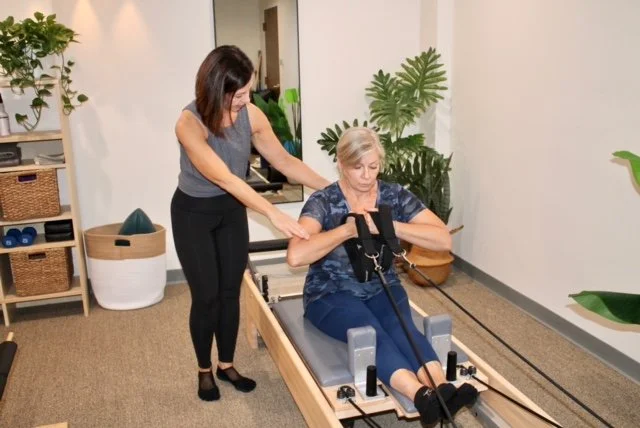
However, Pilates can also be practiced using specialized equipment such as the reformer, chair, and tower. The reformer features a sliding carriage and springs that provide adjustable resistance during exercises. The chair is a compact piece of equipment that challenges balance, strength, and stability, while the tower uses springs and bars to support a wide variety of stretching and strengthening movements.
These pieces of equipment provide both support and challenge, allowing exercises to be modified for beginners while still offering opportunities for progression.
Whether you start with mat Pilates or equipment-based sessions, the same foundational principles apply. Learning proper technique and body awareness early on helps create a strong foundation for future progress.
Can You Do Pilates Without Equipment?
Absolutely. Many beginner Pilates exercises can be performed using nothing more than a mat and a small amount of space.
In fact, mat Pilates is often one of the best ways to learn the foundational principles of the method because it encourages you to rely on your own strength, control, and body awareness. Once you're comfortable with the basics, you may decide to explore equipment-based Pilates classes that incorporate the reformer, chair, or tower.
Whether you practice at home or attend beginner Pilates classes in a studio, the same principles of breathing, alignment, and controlled movement remain the foundation of every exercise.
Tips for Success as a Beginner
Starting Pilates doesn't require special skills or athletic experience. A few simple strategies can help you get the most from your practice:
Focus on quality rather than quantity.
Move slowly and with control.
Pay attention to your breathing.
Be patient with yourself.
Ask questions when you're unsure.
Celebrate progress, even when it feels small.
Remember, everyone in a Pilates class was once a beginner.
Building Confidence Through the Basics
The beauty of Pilates is that the simplest movements are often the most valuable. Foundational exercises teach body awareness, control, stability, and movement patterns that support more advanced exercises later on.
Whether you're exploring Pilates for beginners, researching beginner Pilates classes, looking for beginner Pilates exercises, or preparing for your first Pilates class, learning the basics is an excellent place to start. Over time, those foundational movements can help improve strength, mobility, posture, and confidence both inside and outside the studio.
At Sandy Greiner Pilates, we believe that every Pilates journey begins with a strong foundation. Our instructors help clients build skills gradually, creating a supportive environment where beginners can learn, grow, and gain confidence one movement at a time.
Frequently Asked Questions (FAQs)
Is Pilates good for beginners?
Yes. Pilates is highly adaptable and can be modified for different fitness levels, making it an excellent option for beginners.
What should I expect in my first Pilates class?
Most beginner Pilates classes focus on breathing, alignment, body awareness, and foundational exercises that help you learn the basics of the method.
Do I need to be flexible to start Pilates?
Not at all. Many people begin Pilates because they want to improve flexibility, mobility, and overall movement quality.
Is mat Pilates good for beginners?
Yes. Mat Pilates introduces the fundamental principles of Pilates and is often a great starting point for new clients.
How often should beginners do Pilates?
Many beginners start with one to three sessions per week. Consistency is generally more important than frequency when building strength, mobility, and confidence.
